Where Does Club-Mate Come From?
If you’ve encountered Club-Mate in a Berlin café, a startup office, a university library, or more recently in the United States, you may have wondered: Where is Club-Mate from?
The short answer is Germany.
But the full Club-Mate origin story stretches much further than Germany. The drink brings together a centuries-old South American yerba mate tradition, German beverage-making, and the modern culture of Berlin.
It’s an unusual journey: from the leaves of the yerba mate plant to one of Germany’s most recognizable cult drinks.
Where Is Club-Mate From?
Club-Mate is a German yerba mate drink produced by the Loscher brewery in Bavaria, Germany.
The drink as we know it today carries the Club-Mate name, but its history goes back much further. A mate-based soft drink was already being produced in Germany in the early 20th century, long before Club-Mate became associated with Berlin's programmers, artists, students, and nightlife.
In other words, Club-Mate may feel perfectly at home next to a laptop in a modern coworking space, but the idea behind the drink is more than a century old.
And the ingredient at the heart of it is older still.
It All Starts With Yerba Mate
To understand where Club-Mate comes from, we have to travel far beyond Germany.
Yerba mate originates in South America, where the leaves of the Ilex paraguariensis plant have been consumed for centuries.
Mate has especially deep cultural roots in Argentina, Paraguay, Uruguay, and southern Brazil.
Traditionally, dried yerba mate leaves are placed inside a gourd and steeped in water. The drink is then sipped through a filtered metal straw known as a bombilla.
But mate is about more than caffeine or flavor.
Drinking mate can be a social ritual. It is shared between friends, families, coworkers, and communities. The same gourd may be passed from person to person as people talk, work, relax, or simply spend time together.
That's quite different from opening a cold bottle of Club-Mate.
And yet, the two are connected by the same remarkable plant.
From Yerba Mate Tradition to a German Drink
Germany might not be the first place you'd associate with yerba mate, but the country developed its own chapter in the mate story.
A carbonated mate beverage was being produced in Germany as early as 1924. Decades later, the Loscher brewery acquired the recipe and began marketing the drink under the Club-Mate name.
This transformed traditional yerba mate into something suited to a very different lifestyle.
Instead of preparing hot water, loose mate leaves, a gourd, and a bombilla, Club-Mate could simply be chilled, opened, and enjoyed.
The result was a sparkling beverage with a distinctive herbal, slightly bitter and lightly sweet taste — and naturally occurring caffeine from yerba mate.
But that still doesn't explain how Club-Mate became so closely associated with Berlin.
How Did Club-Mate Become a Berlin Favorite?
Club-Mate isn't actually produced in Berlin.
That's an important distinction.
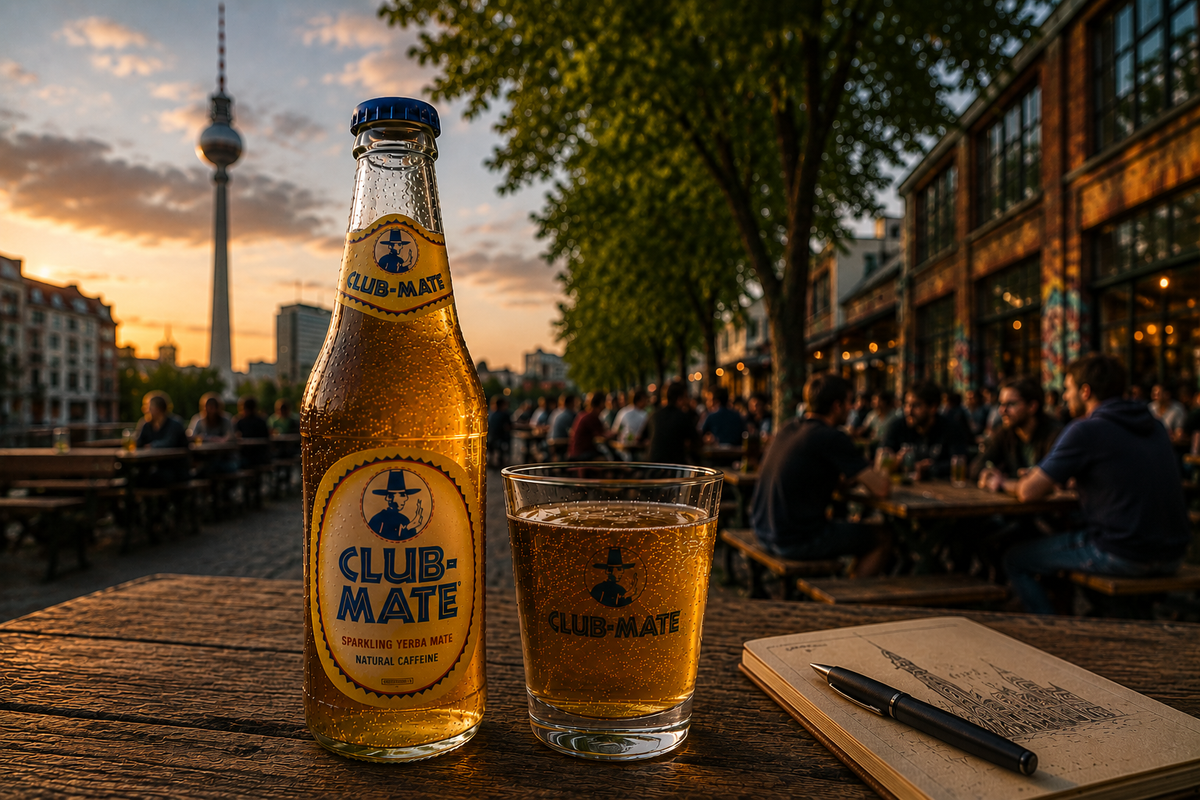
The drink is German and produced in Bavaria, but Berlin became one of the places most strongly associated with Club-Mate culture.
During the 1990s and 2000s, Club-Mate developed a particularly enthusiastic following within hacker and computer communities.
That relationship made sense.
Long coding sessions and naturally caffeinated drinks are a fairly compatible combination.
From there, Club-Mate increasingly appeared in the environments surrounding Berlin's technology and alternative scenes: universities, creative studios, startup offices, coworking spaces, bars, clubs, and late-night events.
Eventually, seeing someone walking around Berlin with a bottle of Club-Mate started to feel completely normal.
Yerba Mate Meets Berlin Culture
The connection between yerba mate and Berlin is an interesting example of how a product can develop a cultural identity far away from the origin of its main ingredient.
Yerba mate carries centuries of South American tradition.
Club-Mate turned it into a German sparkling drink.
Berlin's communities then gave that drink another identity entirely.
It became associated with programmers and hackers, but also artists, musicians, students, designers, founders, gamers, and nightlife.
In that sense, Club-Mate sits at the intersection of several very different worlds.
South American mate tradition.
German beverage culture.
Berlin technology, creativity, and nightlife.
That's a pretty unusual background for something you can simply pull out of a refrigerator.
Why Is Club-Mate Popular With Programmers and Creatives?
Part of the answer is practical: Club-Mate contains caffeine from yerba mate.
It is also cold, carbonated, and ready to drink.
That makes it particularly convenient in environments where people might be working, studying, designing, coding, gaming, or creating for hours at a time.
But culture matters too.
Once a product becomes established within a particular community, it starts to become part of that community's identity.
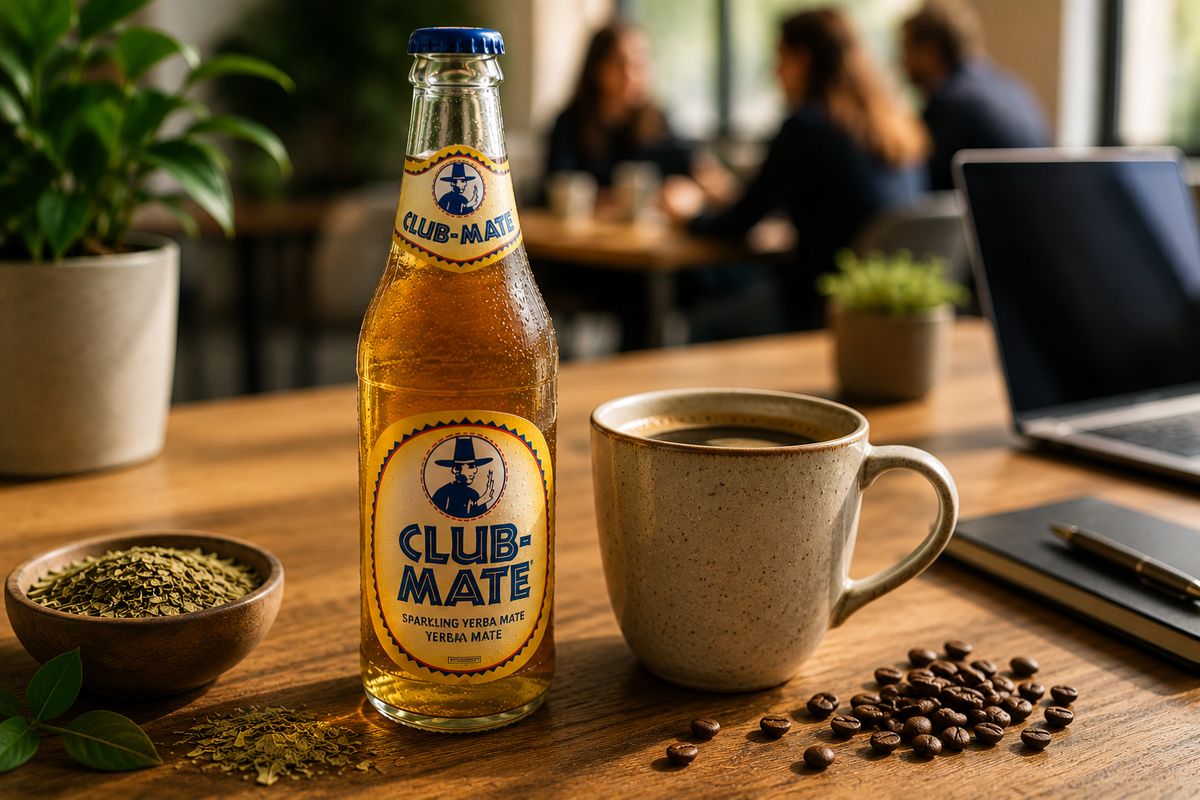
A crate of Club-Mate in a startup office fridge.
A bottle beside a laptop.
Club-Mate at a hacker event.
A cold bottle between stops during a night out in Berlin.
Those associations helped turn the drink from simply another caffeinated beverage into something with a genuine cult following.
Is Club-Mate a German Energy Drink?
You'll sometimes see Club-Mate described as a German energy drink, and it's easy to understand why.
It contains caffeine and is popular in situations where people want to stay alert and focused.
But that description doesn't tell the whole story.
Club-Mate is better understood as a sparkling yerba mate tea with naturally occurring caffeine.
Its characteristic taste comes from yerba mate, and it has a very different flavor profile from the intensely sweet beverages typically associated with the energy-drink category.
It's earthy. Herbal. Slightly bitter. Lightly sweet. And sparkling.
For first-time drinkers, it can be unexpected.
For Club-Mate fans, that's precisely the appeal.
From Berlin to the United States
Today, the culture around Club-Mate has traveled well beyond Germany.
Americans discovering Club-Mate may first encounter it through tech communities, German culture, travel, gaming, universities, nightlife, or simply curiosity about yerba mate.
That introduces another chapter in the drink's unusual journey.
A plant deeply rooted in South American culture became the foundation of a German sparkling beverage. That beverage developed a cult following in Berlin's technology and creative communities. And now new audiences are discovering it in cities across the United States.
The contexts change.
The bottle travels.
But yerba mate remains at the center of the story.
So, Where Does Club-Mate Come From?
Club-Mate comes from Germany, where mate-based soft drinks have a history dating back to the early 20th century and where Club-Mate is produced today.
But the complete story is more interesting than simply putting a pin on a map.
Its roots connect South American yerba mate tradition, German beverage history, and modern Berlin culture.
That's part of what makes Club-Mate difficult to categorize.
It's not simply a soda.
It's not simply an energy drink.
And it's certainly not simply tea.
It's a modern German interpretation of a much older mate tradition — one that found an unlikely home among Berlin's programmers, students, artists, musicians, creatives, and night owls.
From South American mate tradition to Germany, from Germany to Berlin culture, and now from Berlin culture to a new generation of Club-Mate drinkers in the USA.